

Second annual The Future is HER connects variety of industries with AI skills
Could you use artificial intelligence to scan your inbox and summarize messages? Could you use it to build customer audiences or grant opportunities for your business? Or could you use AI to evaluate ideas and proposals for feedback and next steps?
At the second annual The Future is HER event, expert speakers and panelists from across a variety of industries offered the same answer: Absolutely.
 Sponsored by Georgia Artificial Intelligence in Manufacturing, or Georgia AIM, in partnership with Pink STEM and STEM Atlanta, The Future is HER explores ways artificial intelligence is changing career paths — and opening new ones. The event took place March 26 at the Georgia Tech Research Institute Conference Center in Atlanta.
For this year’s event, speakers and panel discussions dove into ways AI is used across industries to add efficiency and expertise to existing jobs. Opening keynote speaker Jennifer Kattula, chief marketing officer at Microsoft Advertising, challenged the audience of professionals and entrepreneurs with the question, “What are you building?” Throughout the day, breakout panels and a midday keynote by Georgia Institute of Technology professor Tim Brown examined how AI can expand existing skill sets.
The trend, they all noted, is clear: Some people are learning how AI can increase efficiency in their workdays, while others are opposed to its intrusion. The lesson was unmistakable: Those who do not learn to use AI will be replaced by those who do.
“By 2030 there will be 78 million new jobs,” said Kattula. “But the right question isn’t, ‘Will my job exist?’ but, ‘Am I building the skills I will need for my job in the future?’”
The good news is, it’s not too late.
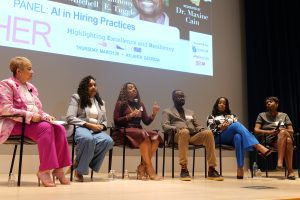 Following Kattula’s opening presentation, which focused on AI’s possibilities through learning new skills and tackling passion projects, breakout panels highlighted tools already in use across industries. These included cybersecurity and IT, manufacturing, financial technology, the cosmetics and hair industries, marketing, public relations and advertising, and creative careers such as film, television and visual arts.
Brown, director of Tech AI and the Georgia Tech College of Lifelong Learning, offered an overview of where AI has been and where it’s going — along with insights into how professionals can use it to their advantage — while a closing panel explored how AI is affecting hiring practices and the job application process.
During the closing reception, which featured networking and a headshot station, attendees also heard from Tina Woodard and Denise Smith during a bonus “fireside chat” on entrepreneurs using AI. Representatives from the city of Atlanta and Goodwill were also on site to speak with job seekers about new opportunities.
Brown cited a quote from “Battlestar Galactica”: “All this has happened before, and all of it will happen again.” He noted the cyclical nature of technological advancement and job disruption. More than a century ago, he said, jobs centered on raising and caring for horses as the primary mode of transportation. Those roles later evolved into automobile sales and repair, as new technology required new skills.
AI is creating a similar dynamic.
“If we think about the mid-’90s, when the internet took over, just think about all the jobs we have now thanks to internet technology,” he said. “We survived the internet, and we’re going to survive AI. I know it’s challenging, but embrace the opportunities.”
Key takeaways from the day included setting aside time to learn how to use AI tools. Panelists encouraged attendees to view AI as an assistant — asking it questions, including how to write prompts for beginners — and to experiment with different models.
Of course, experts also advised being aware of the data shared with AI tools, noting that most free versions use prompts and information to train their models. Still, even in creative fields where AI is often seen as a threat, visual artist Melissa Mitchell said AI tools helped her expand her business.
“I’ll (ask AI) to put my designs in different places and make mock-ups,” she said. By placing her tote bag design into a retail setting, for example, she was able to better pitch it to a national department store chain. “Using chat should not be a threat. Lean into it and not against it.”
Georgia AIM, which sponsored The Future is HER for the second year, is a statewide initiative funded by the U.S. Economic Development Administration. The project supports AI adoption by manufacturers and entrepreneurs across Georgia, as well as workforce training and upskilling for smart technologies. It is jointly led by Georgia Tech’s Enterprise Innovation Institute and the Georgia Tech Manufacturing Institute.
For more information, visit georgiaaim.org.